
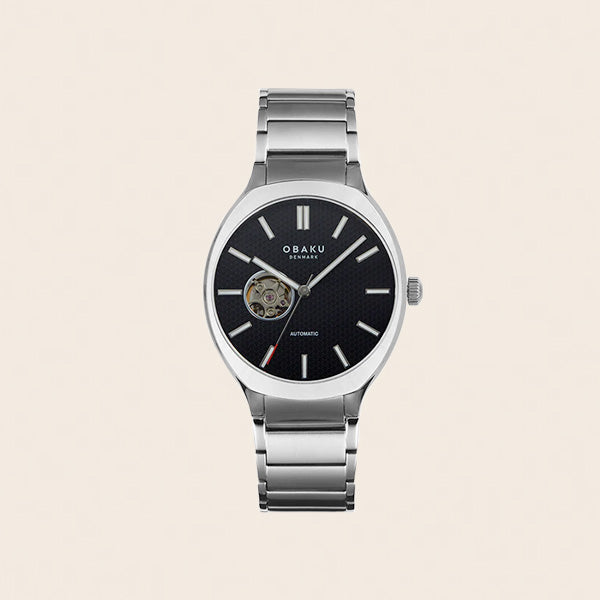
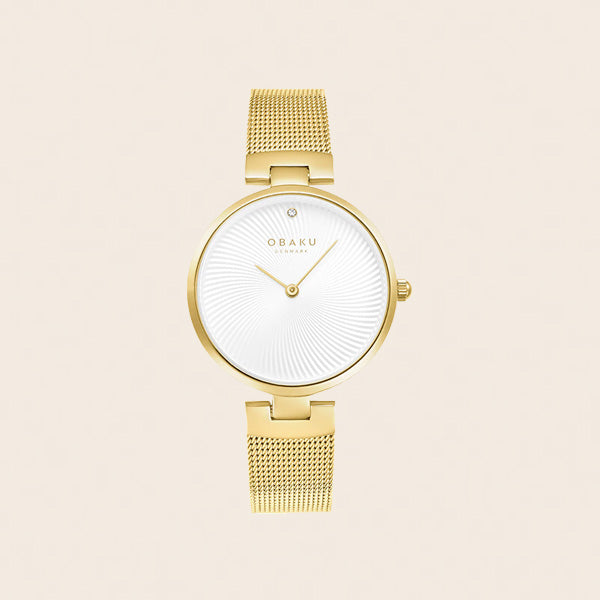
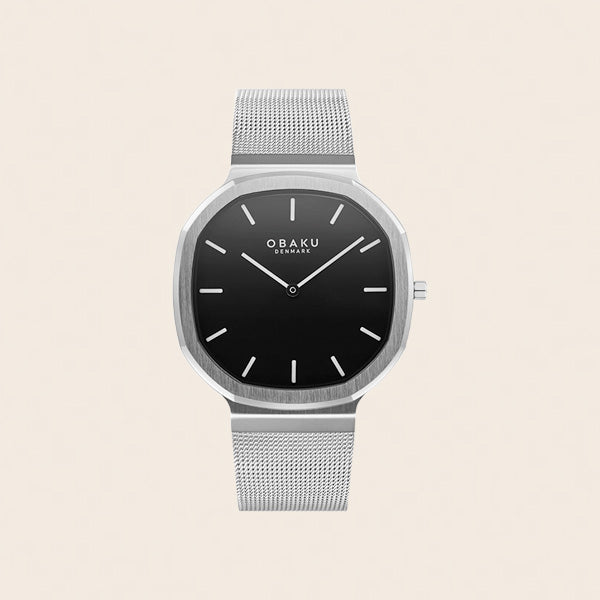

Obaku's Oktant Collection draws its name and form from the octagon—a shape long associated with balance, transition, and architectural grandeur. Designed by Christian Mikkelsen, the collection reimagines Danish minimalist watchmaking through an angular, ultra-slim octagonal watch case that challenges the dominance of the round dial without sacrificing elegance.
There's a reason most watches are round. The circle is the natural geometry of clockwork—gears, springs, and rotating hands all orbit a central point. For centuries, watchmakers have leaned into this logic, and the round case became the default. Rarely questioned. Rarely challenged.
Obaku questioned it.
The Oktant Collection is built around the octagon—eight sides, eight angles, and a design philosophy rooted in the idea that a watch can be both architecturally striking and quietly refined. This isn't a watch that shouts for attention. It earns it through proportion, precision, and a shape that carries centuries of symbolic weight.
Understanding the Oktant means understanding where the octagon comes from, what it means, and why Danish designer Christian Mikkelsen chose it as the foundation for one of Obaku's most distinctive collections.
Why the Octagon? The Meaning and Symbolism Behind an 8-Sided Design
The octagon has appeared in human architecture for thousands of years—from the baptisteries of early Christianity to the towering minarets of the Islamic world, from Roman floor mosaics to the dome of the Florence Cathedral. Cultures across history gravitated toward this shape, not by coincidence, but because of what it represents.
In many traditions, the number eight symbolizes balance and infinity. The octagon sits geometrically between the square (which represents the earthly, the stable) and the circle (which represents the divine, the infinite). It is, in a sense, a shape of transition—a bridge between two states of being. That layered meaning gives the octagon a visual authority that few other forms can claim.
For watchmaking, a craft already steeped in symbolism and tradition, this is fertile ground. The octant—a navigational instrument used by sailors to measure angles and chart their course by the stars—shares its linguistic root with the collection's name. It's a subtle nod to precision, direction, and purpose. A watch, after all, is a tool for measuring something far more elusive than distance: time itself.
The Obaku Oktant watch collection channels all of this. The eight-sided watch design isn't decorative for its own sake. It's intentional, layered, and deeply considered.
Christian Mikkelsen and the Design Vision Behind the Oktant
Obaku has always been defined by restraint. The Copenhagen-based brand was founded on the principles of Danish minimalism—clean lines, honest materials, and a refusal to let ornamentation override function. Christian Mikkelsen, the designer behind the Oktant Collection, worked within this ethos while pushing its boundaries.
The central challenge was this: how do you create an unconventional watch design without creating a difficult one? How do you introduce an angular watch face into a world of round cases without the result feeling abrasive or gimmicky?
Mikkelsen's answer was proportion and flatness. The Oktant's octagonal watch case is ultra-slim by design—a flat, angular watch design that sits low against the wrist rather than rising above it. This keeps the geometric boldness of the octagon in check. The shape makes a statement, but the silhouette remains composed.
The result is a watch that reads as modern without feeling cold. The angularity is softened by the thinness. The boldness is balanced by restraint. It's a design that reflects what Danish minimalist geometric watch design does best: finding beauty in the tension between opposites.
What Makes the Oktant Collection's Construction Stand Out?
An Ultra-Slim Octagonal Watch Case Built for Everyday Wear
The Oktant's case is engineered for comfort as much as aesthetics. A non-round watch case presents real ergonomic challenges—sharp corners can dig into the wrist, and angular edges can feel unforgiving against the skin. Obaku addressed this by keeping the case exceptionally thin and ensuring the eight sides transition smoothly into one another.
The result is a geometric watch that wears surprisingly easily. On the wrist, it feels considered rather than contrived—a watch that happens to be octagonal, not one that's trying too hard to prove a point.
Sapphire Crystal and Mesh Bracelet Options
The Oktant is finished with sapphire crystal glass, one of the hardest transparent materials available to watchmakers. Sapphire crystal resists scratching far more effectively than standard mineral glass, making it the choice of watchmakers who prioritize longevity. For a collection defined by clean surfaces and precise geometry, scratch resistance isn't just practical—it's essential. A scratched dial undermines the entire visual language the Oktant is built on.
Bracelet options include a mesh bracelet—fine interlocked links that complement the geometric watch design without competing with it. The mesh brings a lightness to the watch that balances its angular case, and its adjustable fit means the Oktant can be worn equally well by a range of wrist sizes.
A Dial Designed Around the Shape
The dial of an octagonal watch presents a design problem that doesn't exist with round cases: how do you fill an eight-sided space without it feeling awkward? Obaku's approach is characteristically minimal. The hour markers are restrained, the hands are slender, and the overall composition is oriented toward the center of the dial rather than the edges.
This creates a sense of visual calm within the geometry. The octagon frames the dial rather than competing with it. The shape becomes architecture, and the timekeeping elements sit within it like furniture in a well-designed room.
How the Oktant Fits Into the History of Geometric Watch Design
The non-round watch case has a distinguished, if unconventional, history. Audemars Piguet's Royal Oak—launched in 1972 and designed by Gérald Genta—made the octagonal bezel one of the most recognized shapes in luxury watchmaking. The Cartier Tank stretched the watch case into a rectangle decades earlier. IWC's Ingenieur has played with geometric forms across multiple generations.
What these designs share is an understanding that the departure from the circle must be purposeful. An angular watch face works when its geometry serves the overall character of the watch—when the shape and the story align.
The Obaku Oktant watch collection belongs in this conversation. It doesn't reference the Royal Oak or try to compete with it. Instead, it brings a distinctly Scandinavian sensibility to the octagonal form: quieter, flatter, less ornate, and arguably more wearable for daily life.
For those drawn to bold minimalist watch design—watches that are visually interesting without being visually exhausting—the Oktant occupies a genuinely distinctive position.
Who Is the Oktant Collection For?
The Oktant is designed for men and women who want a watch that does more than tell the time—but without crossing into showmanship. It suits those who appreciate the history behind a design decision, who notice proportion and geometry, and who prefer their accessories to be conversation pieces rather than status symbols.
It works across contexts. On a casual wrist, the slim profile keeps it understated. In a professional setting, the geometric precision reads as intentional and considered. Paired with the mesh bracelet, the Oktant has an almost architectural quality—the kind of watch that architects, designers, and creatives tend to gravitate toward.
The Oktant as an Expression of Obaku's Design Philosophy
Obaku has spent years demonstrating that minimalism and character are not mutually exclusive. A watch can be stripped of excess without being stripped of personality. The Oktant Collection is perhaps the clearest expression of this belief.
By choosing the octagon—a shape with genuine historical and symbolic resonance—Obaku created a collection that gives wearers something to connect with beyond the product itself. The octant navigated by stars. The octagon has held meaning across cultures for centuries. And now, on the wrist, the Obaku Oktant watch collection carries that weight lightly, as the best Scandinavian design always does.
Frequently Asked Questions About the Obaku Oktant Collection
What is the Obaku Oktant Collection?
The Obaku Oktant Collection is a line of octagonal watches designed by Christian Mikkelsen. The collection is defined by its eight-sided watch design, ultra-slim profile, sapphire crystal glass, and Danish minimalist aesthetic. It is available in multiple variants, including options with a mesh bracelet.
Why did Obaku choose an octagonal watch case for the Oktant?
The octagon was chosen for its symbolic and architectural significance. The shape represents balance and transition across many cultural traditions, and its angular form creates a striking visual departure from conventional round watch cases—while still aligning with Obaku's minimalist design values.
Is an octagonal watch comfortable to wear every day?
Yes. The Oktant's ultra-slim, flat case design minimizes the ergonomic challenges that angular watch cases can present. The thin profile means the watch sits close to the wrist, and the edges are designed to feel smooth rather than sharp against the skin.
What materials are used in the Obaku Oktant watch?
The Oktant features a sapphire crystal glass face, which offers superior scratch resistance compared to standard mineral glass. Bracelet options include a mesh bracelet, and the case is crafted to the slim tolerances Obaku's Danish minimalist geometric watch designs are known for.
How does the Obaku Oktant compare to other octagonal watches?
The Oktant is distinguished by its Scandinavian restraint. Where some octagonal watches—such as those in the luxury segment—emphasize bold hardware and intricate finishing, the Obaku Oktant prioritizes thinness, simplicity, and wearability. It is designed for everyday use rather than as a collector's statement piece.
Is the Obaku Oktant suitable for both men and women?
Yes. The Oktant Collection includes options designed to suit a range of wrist sizes and personal styles. Its clean, geometric design language is intentionally gender-neutral, making it a versatile choice for anyone drawn to angular watch face design.

